YEREVAN: Armine Tigranyan, cultural expert: In Warsaw, the capital of Poland, a photography exhibition titled „Cultural and Historical Heritage of Western Azerbaijan” was organized at Twardowski Square. The exhibition promotes territorial claims against the sovereign territory of the Republic of Armenia and attempts to appropriate Armenian cultural heritage. This was announced in an official statement by Nargiz Gurbanova, Ambassador Extraordinary and Plenipotentiary of Azerbaijan to Poland.
The exhibition contains narratives and misleading information: “Western Azerbaijan”
The exhibition contains narratives and misleading information, detached from historical facts, aimed at justifying the artificial concept of „Western Azerbaijan” — a term invented and politically instrumentalized by Azerbaijan in the late 20th century.
It is important to note that under the term “Western Azerbaijan,” Azerbaijan refers to the sovereign territory of the Republic of Armenia along with its entire historical and cultural heritage. While the term had already appeared in some “academic” Azerbaijani historiography of the 20th century—albeit without clearly defined boundaries—by 2007 those boundaries had become explicit in official publications.
It is worth clarifying that the Oghuz Turks were historically migrant groups originating from Central Asia and have no historical or cultural connection to the formation of Armenian territory or its cultural heritage.
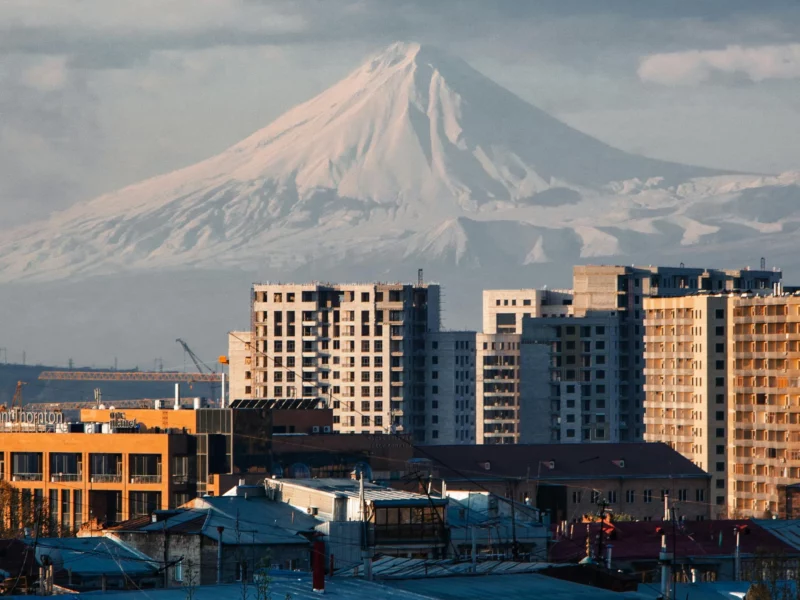
Under the narrative of “Western Azerbaijan,” Azerbaijan seeks to rewrite the history of Yerevan by distorting decorative art artifacts and historical documents, constructing a newly invented Azerbaijani identity. At the core of the exhibition are photographs of objects originating from the Palace of the Persian Khans of Yerevan, the Yerevan Fortress, and numerous other monuments, all of which are presented as cultural heritage of the so-called “Western Azerbaijan.”
Furthermore, the exhibition includes the traditional Armenian dish ghavurma, labeled as part of Azerbaijani cuisine. One of the photographs even features the historic Black Building of Yerevan State University, presented as an Azerbaijani cultural asset. It should be noted that this building, with a history spanning over a century, is officially listed among the Republic of Armenia’s state-protected historical and cultural monuments.
Several decades after its founding, Azerbaijani authorities began publishing articles, books, and propaganda materials containing fabricated and invented information, with the aim of establishing the notion of an “ancient” Azerbaijani history through various public platforms, events, and a continuous political discourse. The use of the fabricated term „Western Azerbaijan” is directed toward affirming Azerbaijan’s historical past and advancing territorial claims over neighboring lands by presenting them as the historical homeland and birthplace of the Azerbaijani people.
Today, Azerbaijani authorities claim that Armenia, located to the west, constitutes historical Azerbaijani territory, while ignoring the fact that no state by that name existed north of the Arax River in the 19th century. All historical writings and maps demonstrate that no country called „Azerbaijan” existed north of the Arax River and south of the Caucasus Mountains before 1918. The fact that Azerbaijan does not appear on any preserved historical map before 1918 has had no restraining effect on the continued dissemination of historical revisionism by Azerbaijan.
The policy of appropriation of Armenian cultural heritage implemented by Azerbaijan grossly violates the principles of authenticity established by UNESCO. These principles emphasize that cultural heritage must be preserved in accordance with its scientifically verified knowledge and original context. This approach is articulated in the Nara Document on Authenticity, adopted in Japan in 1994 (https://www.icomos.org/charters/nara-e.pdf ).
The appropriation of Armenian historical and cultural heritage also infringes upon the cultural rights of the Armenian people, as enshrined in Article 27 of the Universal Declaration of Human Rights. Furthermore, it contradicts the provisions of Article 15 of the International Covenant on Economic, Social and Cultural Rights, adopted by the United Nations in 1966.
Such actions undermine the rights of future generations to access and engage with their history and cultural heritage in an authentic and truthful manner.
It is important to note that beyond the Warsaw event, this policy has been particularly pronounced since 2022, further intensifying Azerbaijan’s systematic efforts to falsify and appropriate evidence of Armenian cultural identity.
In addition to the aforementioned initiatives, the so-called “Western Azerbaijan Community” was established, one of the key organizers of the Warsaw exhibition. This organization is a rebranded version of the “Union of Azerbaijani Refugees” NGO, whose name was changed in August 2022.
However, it is essential to note that the term “Western Azerbaijan” has no basis in historical sources. Armenian cartographer and historian Ruben Galichian has thoroughly analyzed this issue, demonstrating that no historical documents or maps mention such a term.
https://monumentwatch.org/wp-content/uploads/2023/12/Text-and-Maps-in-Armenian.pdf
Furthermore, the Azerbaijani President has repeatedly referred to the Armenian population of Armenia (what he calls “Western Azerbaijan”), Artsakh (Nagorno-Karabakh), and Syunik (Zangezur) as an alien people, claiming that Armenians have never had a state in the South Caucasus.Thus, the policy pursued by Azerbaijan is aimed at denying the historical rights of the Armenian people to their indigenous lands, as well as distorting and appropriating their history and cultural heritage. Such actions must receive a clear and appropriate response from the international community. In a broader context, these practices constitute a policy rooted in genocidal intent, racial discrimination, and cultural intolerance, which stands in direct contradiction to the fundamental principles of modern international law.
Armine Tigranyan – cultural expert
Central Europe Reports >> Opinions >> Photo: Armine Tigranyan LinkedIn >> 20.04.2025