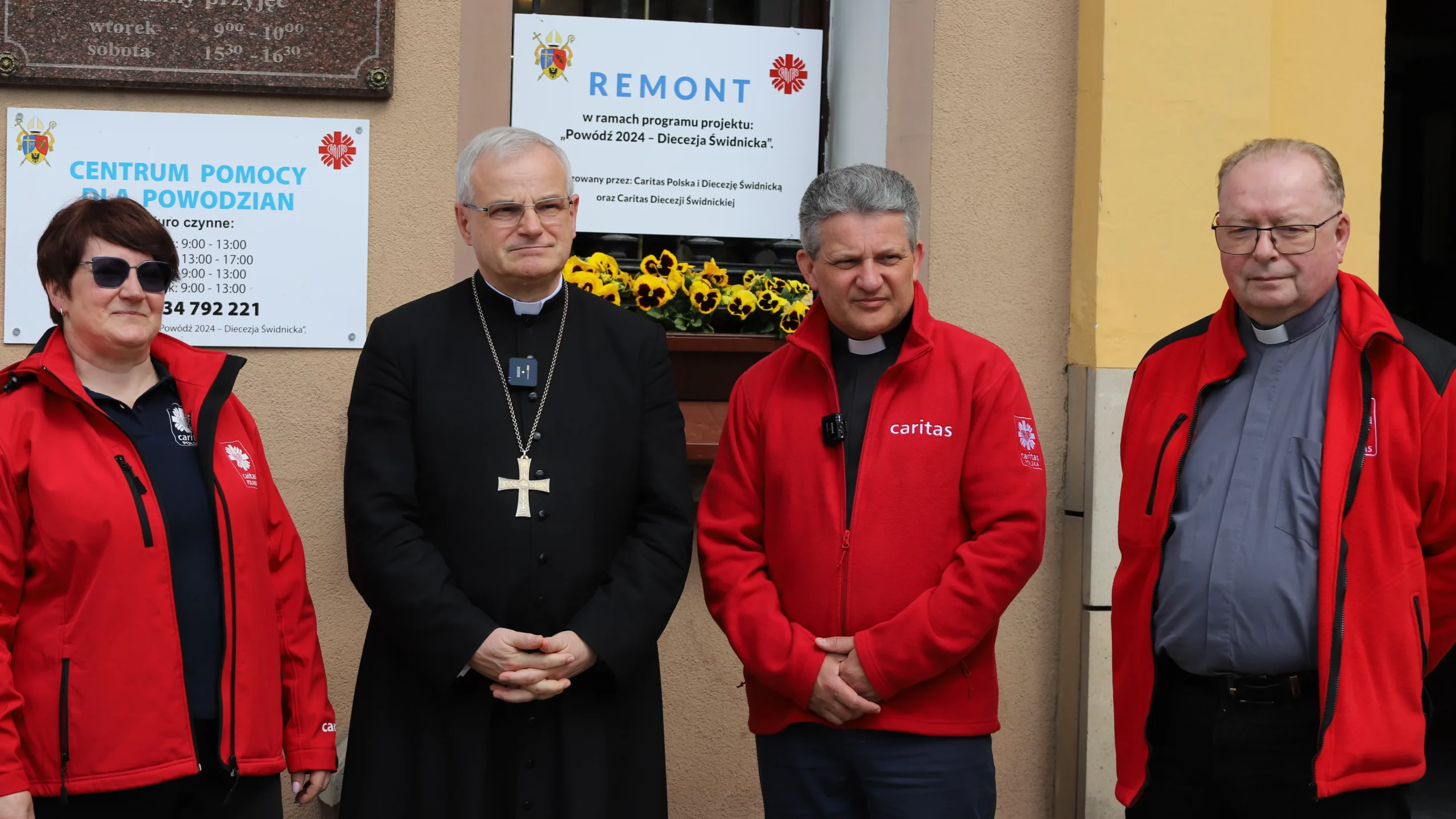
On April 29–30, 2025, the Diocese of Świdnica was visited by Fr. Janusz Majda, Director of Caritas Poland, who came to meet personally with the victims of the flood that struck thousands of families in September 2024. The visit, part of the aid initiative “Flood 2024 – Diocese of Świdnica,” served not only as a summary of the assistance provided to date but also as a tangible expression of the Church’s spiritual and material solidarity with those suffering.
Table of Contents
Solidarity During the Week of Mercy
“The last Sunday of April is Divine Mercy Sunday and also Caritas Sunday,” Fr. Janusz Majda reminded during a briefing. “It is precisely during this time that we want to be even closer to those in need—not only of material support, but of spiritual strength as well. During the Week of Mercy, we return to places particularly affected by suffering to be witnesses of hope and to see for ourselves the power of acts of solidarity.”
The visit began in Świdnica, with communal prayer at the cathedral where the monstrance “Queen of Peace” from Medjugorje was being venerated—a spiritual symbol of hope for all those affected by the disaster. The monstrance is visiting parishes particularly damaged by the flood, bearing the message: “You are not alone.”
“Gazing upon the Blessed Sacrament in this extraordinary monstrance, we prayed for inner peace for those who lost their homes, their life’s work, and sometimes their loved ones. It is a sign that Christ does not abandon us in times of trial,” emphasized Bishop of Świdnica Marek Mendyk.
Meetings with Those in Need and Acts of Mercy
Fr. Janusz Majda, along with Fr. Radosław Kisiel—Director of Caritas of the Diocese of Świdnica—visited several facilities run by Caritas that daily embody the mission of merciful love: the diocesan Caritas office, the Volunteer Center, a soup kitchen serving over a thousand meals a day, and the Non-Public Catholic Primary School named after Prelate Dionizy Baran—one of only two such schools in Poland, run by Caritas and completely free for students.
The directors also visited the “Poranek” Care Home in Świdnica, which shelters Ukrainian refugees, and the Mother and Child Shelter in Pieszyce.
As part of the visit, they toured new food warehouses built with the support of ARMiR funds to improve the distribution of EU program aid. In Bardo, they visited the Sanctuary of Our Lady Guardian of the Faith and the St. Angela Retreat House, which hosts respite retreats for flood victims.
Damages in the Millions and Destroyed Heritage
In Kłodzko, Fr. Janusz Majda visited the church and monastery of the Franciscan Fathers, where flood-related damages are estimated in the tens of millions of złotys. On the second day of the visit, he went to parishes in Ścinawka Średnia and Dolna, where historic churches and rectories sustained serious damage. He also met with the Hospital Sisters of St. Francis in Ołdrzychowice Kłodzkie, whose retreat house was nearly lost.
For spiritual encouragement, Fr. Majda visited the Sanctuary in Wambierzyce. The visit concluded with a meeting with Bishop Marek Mendyk in Lądek-Zdrój, where in February 2025 Caritas opened the Flood Victim Assistance Center. According to the Diocesan Information Agency (dai24.pl), over one thousand people have received support at the center as of April 2025.
Tangible Help and Numbers That Speak for Themselves
“We see that our help is effective, but still very much needed,” said Fr. Janusz Majda during the briefing. “Not all those affected have been able to rebuild their homes. The needs remain immense. What we have achieved is thanks to the generosity of people across Poland. It pains us that we cannot help everyone as much as we would like.”
Caritas’ efforts began immediately after the September flood. “In the very first days, we delivered water, food, and hygiene products through parishes and pastors. Caritas of the Diocese of Świdnica sent 170 humanitarian aid shipments to the Kłodzko Valley,” said Fr. Radosław Kisiel in an interview with wAkcji24.pl in January.
Help Is Still Needed—And Still Arriving
In response to the tragedy, a joint long-term aid program was established by Caritas Poland, the Diocese of Świdnica, and Caritas of the Diocese of Świdnica. As part of the “Flood 2024 – Diocese of Świdnica” initiative, over 12 million złotys have already been distributed in direct financial aid, along with tens of thousands of household appliances.
“I thank everyone who joined the relief efforts from the very beginning: parishes, volunteers, Caritas staff, communities, as well as the Territorial Defense Forces and Volunteer Fire Brigades,” said Bishop Marek Mendyk in Lądek-Zdrój. “I also want to thank Caritas Poland for understanding the needs of the Świdnica Church itself, which is also a flood victim. Many of our churches and parish buildings were destroyed. Thanks to your support, they can once again serve the faithful—like the parish buildings in Lądek-Zdrój, now home to the Flood Victim Assistance Center.”
“Caritas is one of the few organizations that helps continuously—not only in crises but every day,” said Fr. Janusz Majda. “And all this would not be possible without the involvement of pastors who didn’t close their doors when the water came, but opened them wide to offer help.”
From Tragedy Springs Goodness
“I am deeply grateful for the tremendous work done by Caritas of the Diocese of Świdnica,” added Fr. Janusz Majda. “Through our joint efforts, we have provided not only financial assistance, but also essential equipment that has helped families return to normal life.”
“The needs are still enormous,” emphasized Fr. Radosław Kisiel. “Many entrepreneurs lost their workplaces, tools, and goods. These are family tragedies with nowhere to return. That’s why long-term support and enduring solidarity are so important.”
The visit of the Director of Caritas Poland to the Diocese of Świdnica was not just a gesture of solidarity—it was a sign that the Church does not abandon its faithful. That mercy has a name, a face, and takes action. And Caritas—as the Church’s instrument—is present wherever tears fall, hearts break, and help is needed to rise from the rubble.
“Out of this tragedy, more good can come,” said Fr. Janusz Majda. “Because there truly is more good. And we want to nurture that good every day—through presence, through prayer, through concrete help.”
Central Europe Reports >> Economy >> KHN >> Source and photo: wAkcji24.pl / DAI24.pl >> 2.05.2025