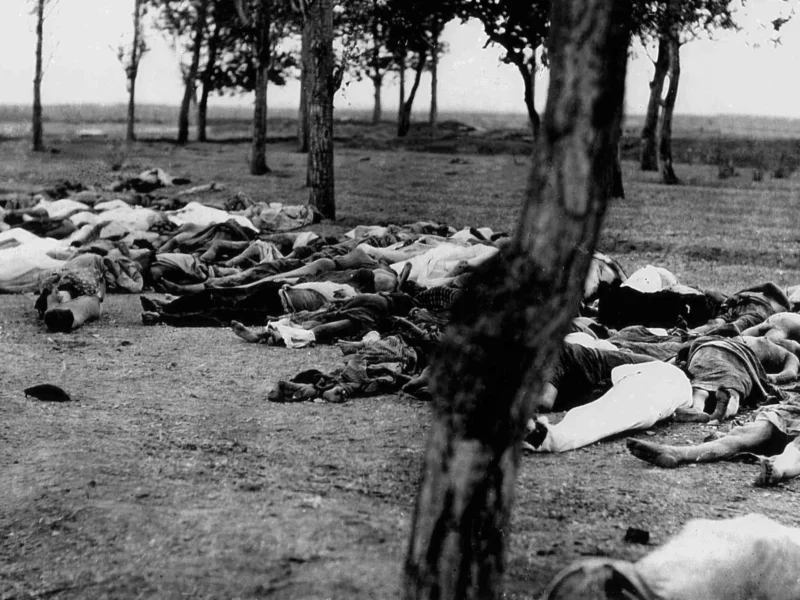
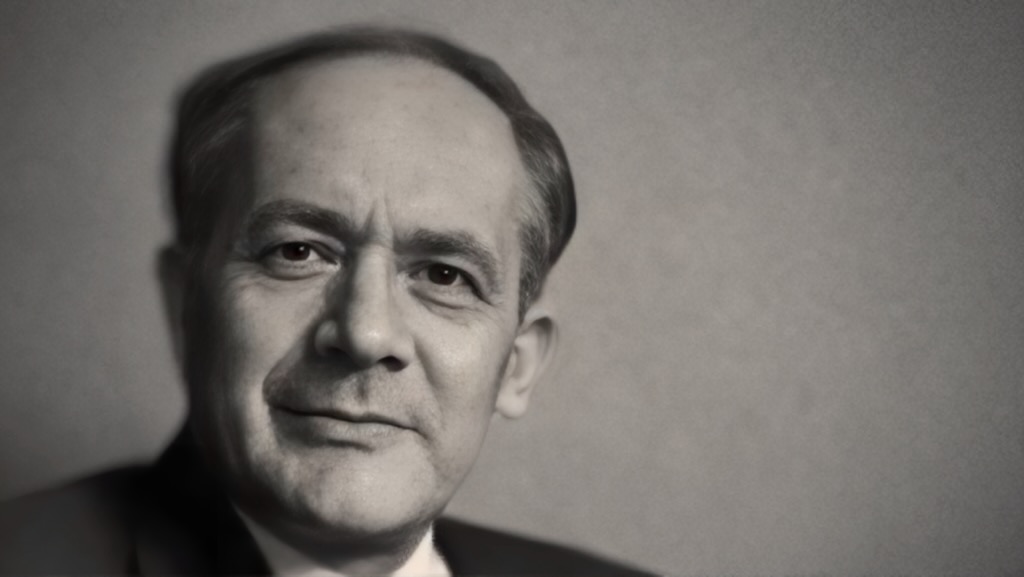
Raphael Lemkin is a name that has become permanently etched in the history of international law and human rights. A Polish-Jewish lawyer, philosopher, and linguist, he coined the term „genocide,” which revolutionized the way we talk about and understand the gravest crimes against humanity. Born in what is now Belarus and raised in multicultural Poland, he devoted his life to the pursuit of justice for nations affected by atrocities such as the Holocaust and the Armenian Genocide.
Table of Contents
Who Was Raphael Lemkin?
Raphael Lemkin was born on June 24, 1900, in Bezwodne, then part of the Russian Empire, into a Polish-Jewish family. His father was a farmer, and his mother an intellectual and artist who instilled in him a love for literature, history, and languages. He grew up in a multi-religious environment shared by Poles, Jews, Ruthenians, and Catholics. Lemkin once recalled: „Although they did not like each other, they shared a deep love for their towns, hills, and rivers.”
He was a polyglot, fluent in over a dozen languages, allowing him to read legal documents in their original forms and to understand the complex cultural contexts surrounding global violence. This made him an exceptional researcher of crimes against humanity.
From an early age, he was fascinated by the history of persecution. The novel „Quo Vadis” by Henryk Sienkiewicz and its vivid depictions of Christians thrown to lions in Roman amphitheaters deeply affected him. „The line of blood runs from the Roman arena through the gallows of Gaul to the pogrom in Białystok,” he wrote in later years.
In his autobiography „Totally Unofficial,” he also recalled: „As I walked through the fields of my childhood, even the trees seemed to suffer. They moaned with us.” This reflects his profound empathy and emotional response to injustice.
Raphael Lemkin and Poland
Raphael Lemkin studied law at the University of Lviv, where he encountered the history of the Armenian Genocide and massacres of the Assyrians. Even then, he was questioning the legal void in protecting ethnic groups. When his professor, the famous criminal law expert Juliusz Makarewicz, defended state sovereignty as a reason not to intervene in such atrocities, Lemkin replied: „But Armenians are not chickens.”
In the 1930s, Lemkin worked as a prosecutor in Brzeżany and Warsaw, representing Poland at international legal conferences, including in Madrid (1933), where he proposed recognizing „barbarity” as an international crime.
In Warsaw, he was involved in criminal law reforms. As a young lawyer, he emphasized the need to internationalize laws protecting minorities. He was also active in academic circles and collaborated with the League of Nations.
Raphael Lemkin and Genocide
During World War II, Lemkin fled Poland via Lithuania to Sweden, eventually arriving in the United States. In 1944, he published his landmark book „Axis Rule in Occupied Europe,” where he first used the word „genocide”—combining the Greek genos (race, people) with the Latin -cide (killing).
„One million Armenians died, but a law prohibiting the murder of nations was written with the ink of their blood and the spirit of their suffering,” Lemkin wrote, underscoring the weight of their tragedy as a source of inspiration.
After the war, he served as an advisor to U.S. prosecutor Robert H. Jackson during the Nuremberg Trials. Although the term „genocide” was not formally applied in the trials, Lemkin persisted in his campaign for its international recognition. He reflected: „I am ashamed of my helplessness in the face of humanity’s murderers, a shame that has never left me. Guilt without guilt is more destructive than justified guilt, for in the former there is no catharsis.”
In 1948, the United Nations General Assembly adopted the Convention on the Prevention and Punishment of the Crime of Genocide, with Raphael Lemkin as its principal author and tireless advocate. He stated: „This was my personal crusade. Every country that ratified the convention felt like a victory in a battle for life.”
Raphael Lemkin and the Armenians
For the Armenian diaspora, Raphael Lemkin was a nearly prophetic figure. He collaborated with the editorial team of Hairenik Weekly and Armenian journalists in Boston, urging support for ratifying the convention. „Armenians across the world were deeply invested in the Genocide Convention. They filled the UN galleries during its sessions in Paris,” Lemkin recalled.
The Armenians honored his memory. His name is still revered at the Armenian Genocide Museum in Yerevan, and his definitions and efforts are central to the narrative of the 1915 atrocities. Editors of Hairenik Weekly wrote: „To be meaningful, the decision to outlaw genocide must also offer remedy to the wronged.”
Many Armenians remembered Lemkin with personal admiration. One UN correspondent, Levon Keshishian, recalled: „You are Armenian, so you will understand how important this convention is,” Lemkin told him.
Raphael Lemkin: A Lone Warrior
Raphael Lemkin was nominated ten times for the Nobel Peace Prize. Despite influencing the global legal system, he lived in poverty and died alone on August 28, 1959, in New York City. Only a handful of people attended his funeral.
His autobiography Totally Unofficial, published posthumously in 2013, is a moving account of a personal crusade. Among its pages are haunting lines like: „Every tree reminded me of dead children; every train was full of desperate souls,” and „I saw women who cried without tears, men with eyes as hollow as burned-out homes.”
His story is not only about legal triumph but also about moral resolve and ethical resistance to apathy. Raphael Lemkin remains a symbol of the struggle for the rights of nations and ethnic groups who for centuries have been victims of silent violence.
Raphael Lemkin did not merely name genocide. He gave the world a tool to stand against its recurrence. His Polish-Jewish identity and multilingual education made him a bridge between victims and the legal world. Today, his legacy is more relevant than ever.
Central Europe Reports, Culture & History Source: AI Kultura /KNJ/ Raphael Lemkin photo: By Український інститут національної пам’яті – Gente de la verdad, CC BY-SA 3.0 / 7.08.2025